

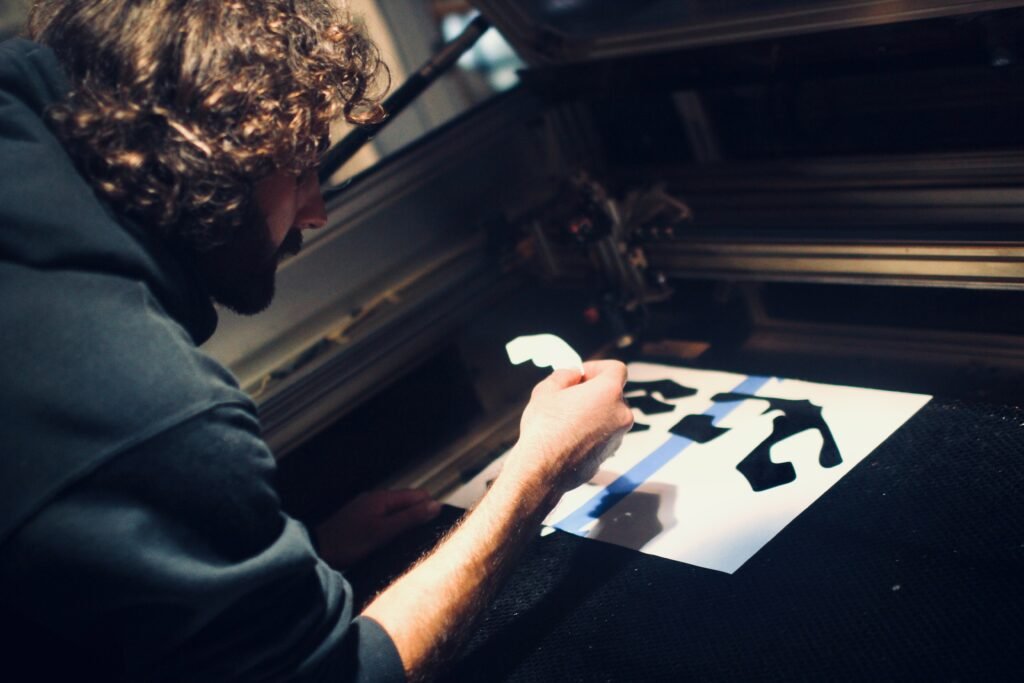
Laser Marking
Permanent, indelible surface marking including barcodes, serial numbers, 2D DataMatrix codes, and high-resolution brand logos without compromising surface integrity.
Industrial Laser Marking & Traceability
Lumicision offers high-speed galvo-driven laser marking systems engineered for high-contrast, permanent tracking markings. Unlike ink stamping, chemical etching, or physical stamping, laser marking does not use consumables and creates marks that resist abrasion, solvent washdowns, and high heat.
Annealing vs. Surface Etching
For medical and aerospace applications where material integrity and corrosion resistance are critical, Lumicision employs laser annealing. This thermally induces a deep dark oxide mark beneath the surface layer without disrupting passivation or creating crevices where bacteria can harbor.
Compatible Materials & Alloys
Our laser systems are optimized with assist gases (Nitrogen, Oxygen, Shop Air) and beam frequency controls for clean cuts across:
Typical Industrial Applications
- ✓ Unique Device Identification (UDI) for Medical Implants
- ✓ VIN, Chassis, and Component Tracking for Automotive
- ✓ Asset Identification & Defense UID Tags
- ✓ Consumer Hardware & Industrial Equipment Plates
- ✓ Electronic PCB & Micro-chip Serialization
Engineering Tolerances & Capability Guide
| Material & Grade | Thickness / Envelope | Feature / Geometry | Standard Tolerance | Process & Assist Notes |
|---|---|---|---|---|
| Medical 316L Stainless Steel & Titanium | All wall gauges & solid rods | Black oxide annealing & UDI DataMatrix | ±0.0004" (±10 µm) positional accuracy | Corrosion-resistant sub-surface anneal surviving 1000+ autoclave cycles |
| Anodized Aluminum (Type II & III Hardcoat) | Sheet, extrusions & CNC housings | High-contrast white bleaching / etching | ±0.0005" (±12.5 µm) | Zero damage to underlying anodic protective barrier |
| Bare Aluminum, Brass & Tool Steels | Solid blocks, shims & stampings | Deep micro-etching & GS1 QR codes | ±0.0005" (±12.5 µm) | Fiber MOPA high-frequency pulse modulation |
| Engineered Polymers (PEEK, ABS, Polycarbonate) | Medical housings, chips & dials | Cold UV color change foaming / bleaching | ±0.0004" (±10 µm) | Zero melt distortion UV 355nm wavelength |
* Tighter non-standard tolerances available upon engineering review. Contact our quality department for specific GD&T and CMM inspection requirements.
Frequently Asked Technical Questions
Will laser marking remove the passive corrosion resistance of medical stainless steel?
No. For medical devices and surgical instruments, we utilize thermal laser annealing. Rather than vaporizing the base material, the laser beam induces controlled localized oxidation beneath the passive chromium-oxide layer, resulting in a dark, high-contrast mark that retains corrosion resistance and survives over 1,000 autoclave steam sterilization cycles.
Can Lumicision produce serialized barcodes, QR codes, and 2D DataMatrix codes?
Yes. Our high-speed galvo scan heads support variable automated serialization, lot codes, date codes, GS1 DataMatrix (FDA UDI compliant), and MIL-STD-130 UID defense barcodes with automated grading to ISO/IEC 15415 and AIM DPM verification standards.
What is the difference between Fiber MOPA and UV cold laser marking?
Fiber MOPA lasers operate at 1064nm with adjustable pulse widths, making them ideal for high-speed deep etching and color-marking on metals. UV cold lasers operate at 355nm, delivering high photon energy that breaks chemical bonds without thermal heat, creating crisp, dark marks on sensitive plastics (PEEK, Delrin, silicone) and glass without surface burning.
What is the turnaround time for laser marking production batches?
Because laser marking requires minimal setup fixturing and zero mechanical tooling, small prototype runs can be completed within 24 to 48 hours, and production runs of thousands of serialized parts can be handled with high-speed automated indexing.
Have CAD Files Ready?
We accept STEP, STP, DXF, DWG, AI, and PDF drawing packages for instant tooling & turnaround evaluation.